
 EN
EN
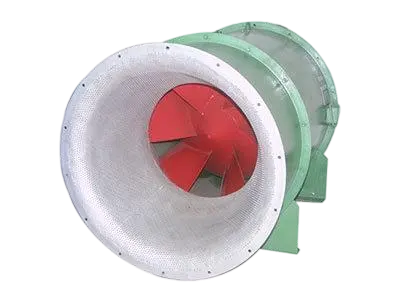
Mixed flow fans, as core components in modern ventilation systems, offer a wide range of air volumes to meet diverse needs, from commercial buildings to industrial facilities. Typically, the air volume provided by mixed flow fans can range from a few cubic meters per second to several hundred thousand cubic meters per hour, depending on the fan model, design parameters, and application scenarios. Selecting the appropriate air volume is crucial for ensuring system efficiency and energy consumption control.
Working Principle and Air Volume Characteristics of Mixed Flow Fans
Mixed flow fans combine the advantages of axial and centrifugal fans. Airflow enters the impeller axially and is influenced by centrifugal force before being discharged diagonally. This unique design enables them to deliver higher air volumes than pure axial fans under medium-pressure conditions while maintaining greater efficiency than centrifugal fans. The air volume primarily depends on impeller diameter, rotational speed, blade angle, and motor power.
Key Factors Influencing the Air Volume of Mixed Flow Fans
-
Impeller Design and Diameter: Impeller diameter directly affects air volume. Generally, larger diameters result in higher air volumes. For example, a mixed flow fan with a 500mm diameter may provide approximately 5000-10,000 m³/h, while a 1000mm diameter fan can reach 20,000-40,000 m³/h.
-
Rotational Speed and Power: Air volume is usually proportional to rotational speed. Fans equipped with high-efficiency motors can deliver greater air volumes at the same power. Intelligent control systems can adjust speed to vary air volume on demand, saving energy.
-
System Pressure and Resistance: Actual air volume is influenced by system resistance, such as duct length, bends, and filters. Selection must consider the total pressure parameter to ensure the fan can deliver the required air volume under system resistance.
-
Application Environment: Temperature, humidity, and altitude affect air density, thereby altering air volume performance. High-temperature or high-altitude environments may require larger fan specifications.
Typical Application Scenarios and Air Volume Ranges
-
Commercial Building Ventilation: Small to medium-sized mixed flow fans typically provide 2000-20,000 m³/h, suitable for daily ventilation in malls and offices.
-
Industrial Smoke Exhaust and Process Ventilation: Large mixed flow fans can achieve air volumes exceeding 50,000 m³/h, used for workshop heat dissipation, smoke extraction, or production line cooling.
-
Fire Smoke Exhaust Systems: Dedicated mixed flow smoke exhaust fans must meet high air volume demands during emergencies, typically ranging from 30,000 to 150,000 m³/h, ensuring rapid smoke removal.
How to Accurately Select the Air Volume for Mixed Flow Fans?
-
Calculate Required Air Volume: Base calculations on space volume, air change rates (e.g., 10-20 times per hour), or process requirements. For example, a 1000m³ workshop requiring 15 air changes per hour needs an air volume of 15,000 m³/h.
-
Consider Safety Factors: It is advisable to include a 10-20% margin to accommodate future demand changes or system aging.
-
Consult Professional Manufacturers: Reliable manufacturers like our company, equipped with advanced fan performance testing laboratories, can provide customized solutions based on specific working conditions, ensuring fans achieve rated air volumes in real-world environments.
Our Technology and Quality Assurance
Our production workshop features intelligent production lines and a strict quality management system. Each mixed flow fan undergoes performance testing under standard conditions to ensure air volume, pressure, and other parameters meet specifications. Products utilize high-quality materials and aerodynamic designs, delivering stable, high air volumes while maintaining low noise and high energy efficiency.
When selecting mixed flow fans, air volume is just one of many metrics. Pressure, efficiency, noise, and reliability are equally important. We recommend contacting our engineering team for professional selection support tailored to your project, ensuring optimal performance and long-term cost-effectiveness for your ventilation system.