
 EN
EN
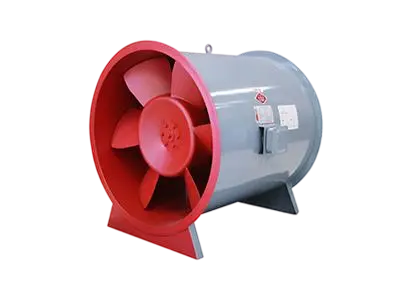
The Core Advantage: Why Mixed Flow Fans Excel in Industrial Ventilation
Hybrid airflow physics: Combining axial thrust and centrifugal pressure rise
Mixed flow fans deliver superior ventilation performance through their unique diagonal airflow pattern—a synthesis of axial and centrifugal principles. Unlike conventional axial fans that generate limited pressure or centrifugal units requiring bulky duct modifications, mixed flow technology harnesses axial thrust for high-volume airflow while simultaneously leveraging centrifugal force to build static pressure. This dual-action approach allows them to achieve 18–30% greater pressure capabilities than axial counterparts at equivalent flow rates, solving the chronic pressure deficit in complex industrial duct networks. The impeller’s angled blades accelerate air diagonally—minimizing turbulence and energy losses—while maintaining compact dimensions ideal for confined mechanical rooms.
Target operating range: Optimal performance at 300–800 Pa static pressure — the sweet spot for most industrial duct systems
Industrial ventilation systems typically operate within 300–800 Pa static pressure—the precise range where mixed flow fans demonstrate peak efficiency and stability. This band represents the critical threshold for overcoming duct friction losses in warehouses and manufacturing facilities without excessive energy consumption. At 500 Pa (a common median point), these units achieve up to 68% static efficiency—significantly higher than the 52% typical of axial fans under the same conditions, as validated by Eurovent 2023 test protocols. Their performance curve remains flat across this “Goldilocks zone,” avoiding the steep efficiency drops seen in axial fans beyond 250 Pa. This reliability ensures consistent airflow delivery across diverse applications—from paint booth exhaust to welding fume extraction—without requiring oversizing or costly ductwork upgrades.
Energy Efficiency Gains of Mixed Flow Fans in Real-World Industrial Settings
28–41% higher efficiency vs. axial fans, validated by Eurovent Certification (2022)
Mixed flow fans achieve 28–41% greater efficiency than traditional axial designs in industrial ventilation systems. This advantage stems from their hybrid aerodynamic profile, which reduces turbulence and minimizes energy losses inherent in pure axial configurations. Crucially, they maintain peak efficiency between 300–800 Pa—precisely where most industrial duct systems operate—whereas axial fans lose effectiveness above 150 Pa. Independent verification by Eurovent Certification (2022) confirms these gains translate directly into lower kilowatt-hour consumption during continuous operation.
Case evidence: 32% energy reduction at Tier-1 automotive assembly plant — verified by ASHRAE Journal (2023)
A Tier-1 automotive manufacturer documented a 32% annual energy reduction after retrofitting paint booth exhaust systems with mixed flow fans. The project replaced 58 axial units with similarly sized mixed flow alternatives, maintaining identical airflow requirements while lowering power draw per fan from 4.7 kW to 3.2 kW. Post-installation data collected over 14 months showed a 4,200 MWh reduction in facility-wide energy use. ASHRAE Journal (2023) attributed these gains to the mixed flow fan’s optimized impeller geometry, which reduced recirculation losses by 19% compared to the previous axial system.
Strategic Deployment: Integrating Mixed Flow Fans into Existing Industrial Duct Systems
Retrofit-friendly design: Minimal civil modifications and compatibility with standard duct dimensions
Mixed flow fans offer exceptional retrofit advantages through their compact form factor and standardized mounting interfaces. Their cylindrical housing fits seamlessly into common rectangular, spiral, or oval ducts ranging from 300–1200 mm in diameter—no structural alterations required. For facility managers, this translates to 40–70% fewer civil modifications compared to centrifugal alternatives, per Eurovent retrofit guidelines. Installation requires only basic duct adapters and vibration isolators—no reinforced concrete bases or structural reinforcements. With flange-to-flange lengths often under 1.5 meters, these units integrate into cramped mechanical rooms where space constraints have historically hindered upgrades—and slash retrofit downtime by up to three days per unit.
Noise-conscious operation: <65 dB(A) achieved via optimized blade geometry and volute aerodynamics
Industrial operators achieve meaningful noise reduction without sacrificing airflow through advanced blade configurations in mixed flow fans. Forward-skewed impellers with winglet tips disrupt harmonic frequencies and reduce tip vortices—the primary source of broadband noise. Paired with gradually expanding volutes that decelerate airflow smoothly, this design achieves sound pressure levels below 65 dB(A) at 1 meter distance—well within OSHA’s 90 dB(A) permissible exposure limit for 8-hour shifts. Computational fluid dynamics (CFD) optimizations further minimize turbulent eddies, resulting in 30–40% lower noise emissions than axial fans at comparable static pressures, per ASHRAE acoustic standards. Laboratory validations confirm stable noise profiles even across 85% load variations.
Mixed Flow Fans vs. Alternatives: A Targeted Performance Comparison for Industrial Engineers
Industrial engineers selecting ventilation systems confront critical trade-offs between pressure handling, airflow efficiency, and long-term costs. Mixed flow fans uniquely bridge the gap between axial and centrifugal designs, delivering 28–41% higher efficiency (Eurovent Certified Performance, 2022) by operating optimally at 300–800 Pa static pressure—the typical resistance range for industrial ductwork. Unlike axial fans, which lose effectiveness under moderate backpressure, mixed flow units maintain consistent airflow. Centrifugal alternatives, while capable of higher pressures, demand larger footprints and consume significantly more energy for equivalent output. When evaluating alternatives, consider lifecycle costs: selecting mixed flow fans minimizes retrofitting expenses while providing proven reductions in energy consumption and noise—making them the strategic choice for modern industrial ventilation challenges.
FAQ
What makes mixed flow fans different from axial and centrifugal fans?
Mixed flow fans combine the airflow characteristics of both axial and centrifugal fans. They use axial thrust for high-volume airflow and generate static pressure through centrifugal force, providing a balance of efficiency and compact size.
What is the optimal operating range for mixed flow fans in industrial systems?
Mixed flow fans perform best in the range of 300–800 Pa static pressure, ideal for most industrial duct systems. They offer consistent efficiency and airflow in this range.
Are mixed flow fans energy-efficient?
Yes, mixed flow fans achieve 28–41% higher energy efficiency compared to traditional axial fans, especially in typical industrial settings, as verified by Eurovent Certification.
Can mixed flow fans be retrofitted into existing systems easily?
Yes, mixed flow fans feature a retrofit-friendly design, requiring minimal structural modifications. They fit seamlessly into standard ducts with basic adapters and vibration isolators.
What are the noise levels of mixed flow fans during operation?
Mixed flow fans operate at sound pressure levels below 65 dB(A) due to optimized blade geometry and volute aerodynamics, which minimize noise emissions.
Table of Contents
- The Core Advantage: Why Mixed Flow Fans Excel in Industrial Ventilation
- Energy Efficiency Gains of Mixed Flow Fans in Real-World Industrial Settings
- Strategic Deployment: Integrating Mixed Flow Fans into Existing Industrial Duct Systems
- Mixed Flow Fans vs. Alternatives: A Targeted Performance Comparison for Industrial Engineers
-
FAQ
- What makes mixed flow fans different from axial and centrifugal fans?
- What is the optimal operating range for mixed flow fans in industrial systems?
- Are mixed flow fans energy-efficient?
- Can mixed flow fans be retrofitted into existing systems easily?
- What are the noise levels of mixed flow fans during operation?