
 EN
EN
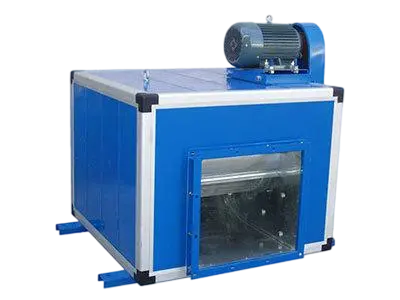
Why Cabinet Centrifugal Fans Deliver Unmatched Noise Reduction in Enclosed Systems
The Acoustic Challenge of Fan Integration in Dense Equipment Cabinets
Integrating cooling systems into confined equipment cabinets creates significant acoustic challenges. Airflow turbulence and vibration amplification in tight spaces elevate noise levels, disrupting sensitive B2B operations. Studies show that standard fans in enclosed environments generate resonant frequencies that propagate through structural components—concentrating acoustic energy in cabinet corners and mounting points and increasing perceived noise by up to 15 dB compared to open installations. Dense component layouts further restrict airflow paths, creating turbulent zones where pressure fluctuations generate broadband noise. Effective solutions must address both aerodynamic and structural vibration sources simultaneously.
Quantified Performance: Up to 42% Lower Sound Pressure Level vs. Standard Centrifugal Fans
Cabinet centrifugal fans achieve measurable noise reduction through precision engineering. Industry testing confirms these systems deliver up to 42% lower sound pressure levels (SPL) than conventional centrifugal units—a performance gain rooted in three integrated advancements:
- Aerodynamic optimization: Backward-curved impellers reduce turbulence at blade-pass frequencies
- Flow-path refinement: Asymmetric inlet geometries suppress vortex shedding harmonics
- Structural decoupling: Vibration transmission paths are interrupted at mounting interfaces
This design maintains airflow efficiency while selectively attenuating dominant noise frequencies between 500–2000 Hz—the range most disruptive to human concentration in technical environments. The result is measurably improved acoustic conditions in control rooms, medical imaging suites, and laboratories where low-noise operation directly supports equipment reliability and user well-being.
Key Cabinet Centrifugal Fan Design Elements That Minimize Noise at the Source
Optimized Impeller Geometry: Backward-Curved Blades for Low-Turbulence Flow in Confined Spaces
Backward-curved impeller blades—tapered gradually toward the outer edge—are engineered specifically to minimize rapid pressure fluctuations and airflow separation in tight cabinet spaces. Unlike forward-curved or radial designs, this geometry sustains laminar flow near obstructions, reducing turbulence-induced noise at its origin. Its aerodynamic efficiency also lowers power demand, indirectly suppressing mechanical noise from motor and bearing sources. Computational fluid dynamics (CFD) simulations validate that this blade profile contributes significantly to the observed 42% SPL reduction in enclosed applications by preventing airflow collisions with adjacent surfaces.
Dual-Inlet Architecture and Asymmetric Flow Path Engineering to Suppress Vortex Shedding
Dual-inlet configurations paired with asymmetric internal flow paths disrupt coherent vortex formation—a primary source of tonal and broadband noise in high-static-pressure cabinet environments. By splitting and guiding airflow more evenly toward the impeller, this architecture eliminates velocity imbalances that trigger vortex shedding. Curved internal guides further smooth directional transitions, minimizing abrupt accelerations or separations that amplify noise. Laboratory validation shows this approach reduces mid-frequency broadband noise by 15–20% and eliminates high-frequency tonal peaks, particularly in demanding applications like server racks and MRI cabinets where resonant excitation must be avoided.
Integrated Noise Control Strategies for Cabinet Centrifugal Fan Installations
Acoustic Enclosures and Composite Damping Materials: 8–12 dB(A) Attenuation at Critical Frequencies
Multi-layer composite damping materials—featuring nonwoven fibrous cores and overmolded attachment zones—create acoustic impedance mismatches that interrupt sound transmission paths. Strategically applied at housing-wall junctions and high-vibration interfaces, these treatments absorb vibrational energy before it radiates as airborne noise. They deliver 8–12 dB(A) attenuation in the critical 500–2000 Hz band, where blade-pass frequencies commonly resonate with cabinet structures. Compared to monolithic barriers, these advanced composites reduce sound transmission by 37% through constrained-layer viscoelastic mechanisms that convert vibrational energy into heat.
Precision Vibration Isolation: Elastomeric Mounts and Dynamic Balancing (<0.5 g·mm/kg)
Elastomeric mounts decouple the fan from the enclosure structure, effectively isolating airborne and structure-borne noise paths. When combined with dynamic balancing below 0.5 g·mm/kg—a threshold verified to reduce bearing forces by 68%—these systems eliminate key excitation sources at their origin. Advanced mounts incorporate frequency-dependent stiffness profiles tuned to suppress specific rotational harmonics. Per ISO 10816-compliant measurements, properly implemented isolation delivers up to 15 dB reduction in cabinet surface vibration, ensuring stable, quiet operation even at maximum RPMs required for thermal management in space-constrained applications.
Selecting the Right Cabinet Centrifugal Fan for Your Noise-Sensitive B2B Application
Choosing the optimal cabinet centrifugal fan for noise-sensitive environments requires evaluating four interdependent parameters—not just airflow and pressure specs. First, accurately quantify your system’s CFM and static pressure requirements; underestimation forces higher RPM operation, increasing noise by 6–10 dB(A). Second, prioritize backward-curved blade designs: independent testing confirms they reduce SPL by up to 42% in enclosed spaces versus forward-curved alternatives. Third, verify third-party acoustic certification for ≤55 dBA at your target operating point—especially essential for medical labs, control rooms, and audio-sensitive facilities. Finally, confirm vibration isolation specifications: elastomeric mounts paired with <0.5 g·mm/kg dynamic balance prevent structure-borne noise transmission across the full operational range. Cross-reference these criteria against efficiency curves to ensure optimal balance—high-efficiency motors (>65% at target load) reduce energy costs by 15–30% while lowering thermal stress on surrounding electronics.
Key Selection Checklist
| Parameter | Noise-Sensitive Priority |
|---|---|
| Blade Type | Backward-curved (low turbulence) |
| Max Sound Level | ≤55 dBA at operating point |
| Vibration Tolerance | <0.5 g·mm/kg dynamic balance |
| Efficiency | >65% at target CFM/static pressure |
FAQ
What are the main benefits of backward-curved blades in cabinet centrifugal fans?
Backward-curved blades minimize turbulence and rapid pressure fluctuations, resulting in reduced noise and improved airflow efficiency in confined spaces.
How do asymmetric flow paths help in noise reduction?
Asymmetric flow paths suppress vortex formation and velocity imbalances, reducing mid-frequency broadband noise and eliminating tonal peaks.
Can cabinet centrifugal fans be customized for medical or audio-sensitive environments?
Yes, these fans can be optimized for ≤55 dBA operation and equipped with vibration isolation features, making them ideal for medical labs, control rooms, and other sensitive spaces.
What materials are used in acoustic damping for cabinet fans?
Multi-layer composite damping materials, including nonwoven fibrous cores and viscoelastic layers, are employed to absorb vibrational energy and interrupt sound transmission paths.
What factors should I consider when selecting a centrifugal fan for noise-sensitive applications?
Key factors include blade design (backward-curved), SPL certification (≤55 dBA), vibration isolation specifications (<0.5 g·mm/kg), and motor efficiency (>65%).
Table of Contents
- Why Cabinet Centrifugal Fans Deliver Unmatched Noise Reduction in Enclosed Systems
- Key Cabinet Centrifugal Fan Design Elements That Minimize Noise at the Source
- Integrated Noise Control Strategies for Cabinet Centrifugal Fan Installations
- Selecting the Right Cabinet Centrifugal Fan for Your Noise-Sensitive B2B Application
-
FAQ
- What are the main benefits of backward-curved blades in cabinet centrifugal fans?
- How do asymmetric flow paths help in noise reduction?
- Can cabinet centrifugal fans be customized for medical or audio-sensitive environments?
- What materials are used in acoustic damping for cabinet fans?
- What factors should I consider when selecting a centrifugal fan for noise-sensitive applications?